Today's LinkedIn Patches #87 Answer
Find today's LinkedIn Patches answer with verified grid solutions, smart hints, and accurate solutions for the latest daily puzzle in this linkedin game. Our Patches game guide helps you solve faster and keep your streak alive.
Today's Patches Answer (Jun 12, 2026)
Today's Patches Expert Logic
🧩 Deep Logic Analysis
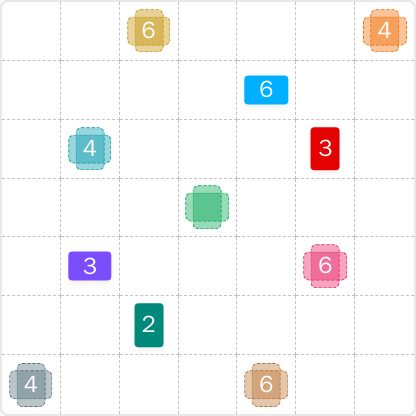
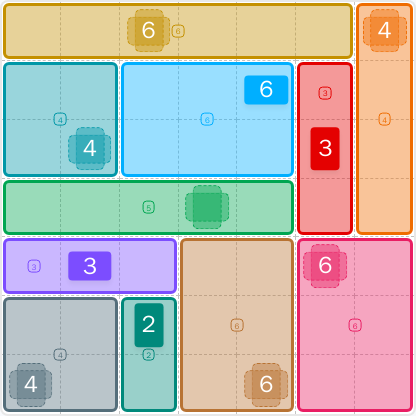
To solve Patches #87, we must look at the constraints of the grid. The logic flows from the most restricted areas—the corners and the long strips—inward to the center.
1. The Top-Down Anchor
The Yellow 6 at the top center is the primary pivot. Because it is positioned in the first row, a vertical or would prematurely block the middle columns. Instead, it forms a horizontal strip. This forces the Orange 4 in the top-right corner to become a vertical column, as there is only one column of width remaining on that edge.
2. The Eastern Wall
With the Orange 4 taking a vertical path, the Red 3 is squeezed. To avoid overlapping with the Blue 6 or the Pink 6, it must also adopt a vertical orientation, specifically a strip. This "stacking" of vertical shapes on the right side is a classic Patches maneuver that clears the center for more complex blocks.
3. The Central Squeeze
The Green 6 sits in the dead center. Given the vertical walls we built on the right, the only way to accommodate 6 tiles without colliding with the Teal 4 or Blue 6 is a horizontal bridge. Once this is placed, the Teal 4 is pushed into a square configuration in the upper-left quadrant, as a strip would no longer fit.
4. Closing the Bottom Quadrant
The remaining pieces fall like dominoes. The Gray 4 claims the bottom-left corner. This leaves a narrow gap for the Dark Green 2 to act as a vertical buffer. Finally, the Tan 6 and Pink 6 resolve into vertical rectangles to fill the remaining 12 tiles in the bottom-right area.
🎓 Lessons Learned From Patches #87
- The Perimeter Priority: Always look at numbers adjacent to the edges first. In this grid, the Yellow 6 and Orange 4 dictated the orientation of every other shape. By solving the "frame," the interior logic becomes much clearer.
- Parity and Packing: When you see a grid (49 tiles), and your clues add up to 44 (6+4+6+4+3+6+3+2+6+4), you know there are exactly 5 empty cells. Strategic practice involves identifying where these "dead zones" are likely to fall—usually between two long strips that can't touch.
- Square vs. Strip: If a number like 4 has two options ( or ), look at the neighboring numbers. If the neighbor is a prime number like 3, it usually forces the 4 into a square to allow the 3 to "breath" as a strip.
💡 Trivia
- The Power of 3: The number 3 appears twice in this grid (Red and Purple). In geometry, 3 is the only number of tiles that must form a straight line to remain a rectangle; it is the simplest "strip" shape in the game.
- Area Efficiency: A strip (like the Green or Yellow patches) has a perimeter of 14 units, whereas a block (like the Pink or Tan patches) has a perimeter of only 10 units. Despite having the same area, strips are "expensive" in logic puzzles because they block more potential connections.
❓ FAQ
Why couldn't the Teal 4 be a horizontal strip?
If the Teal 4 were horizontal, it would overlap with the Blue 6 or the Green 6. The square is the only shape that allows the Green 6 to maintain its horizontal path across the middle of the grid.
Could the Pink 6 in the bottom right have been a vertical strip?
No, because a vertical strip would have collided with the Red 3 or forced the Orange 4 out of its corner. The rectangle is required to flush against the bottom edge while respecting the territory of the Tan 6.
What determines the placement of the empty gray cells?
Empty cells are a byproduct of the "no-touching" rule for shapes of the same color (though not applicable here) and the rigid rectangular constraints. In #87, the gaps appear primarily to prevent "thick" blocks from overlapping in the high-density center.
Recent LinkedIn Patches Answers
View More Patches Answers →
Patches Tips & Expert Strategies
Mastering the Grid-5 Pro Strategies to Solve LinkedIn Patches Faster
The Gaming Revolution- Why LinkedIn is Betting Big on Puzzles Like "Patches
Beyond the Scroll - Why LinkedIn Patches is Your New Morning Coffee Ritual
View More Strategic Insights
Why Use Our Patches Answer Guide?
⚡ Instant Answers
Skip the trial and error. We provide high-resolution solutions for every daily grid. Our visual guides show you exactly how each shape fits, helping you solve any puzzle in seconds.
🔥 Save Your Streak
Don’t let a complex shape or a tricky layout break your progress. We offer the logical backup needed to maintain your LinkedIn winning streak every single day, regardless of the grid’s difficulty.
📅 Daily Updates
Always synced with the official schedule. Stay current with fresh solutions every 24 hours. We ensure the latest Patches answer is ready the moment you start your morning routine, making it the perfect resource for your daily cognitive practice.
Frequently Asked Questions
What is LinkedIn Patches and how do you play?
LinkedIn Patches is a daily logic puzzle where you fill a grid with non-overlapping rectangles. Each number indicates the total area (cells) that shape must occupy. Simply follow the background shading for shape constraints and ensure every cell on the board is covered. Master these patterns through consistent daily practice. Learn How to Play Patches Here.
What is the goal of LinkedIn Patches?
The goal is to divide the grid into non-overlapping rectangles (including squares). Each number in the grid represents the total area (number of cells) that its corresponding shape must occupy.
What do the different shaded backgrounds mean?
These are shape constraints. A Solid Square must have equal sides; a Tall Rectangle must be vertical; a Wide Rectangle must be horizontal. A Dashed Pattern means the area can be any valid rectangle.
Does the grid size change every day?
Yes. Grid dimensions and complexity vary daily to keep the challenge fresh. Higher difficulty levels often feature larger layouts that require more advanced spatial reasoning.
How can I improve my solving speed?
Consistent daily practice is the best way to improve. Start by locking in "prime number" shapes and edge constraints first, as these usually have the fewest possible logical placements.
Is there only one correct solution?
Yes. Every daily puzzle is designed to have a unique logical solution that fills the entire grid perfectly with no empty cells remaining.
Today’s Mini Sudoku Answer is Ready
Get the latest LinkedIn Mini Sudoku solution and expert logic to save your streak.
Reveal Today’s Mini Sudoku AnswerMedia & Featured In