
LinkedIn Patches #54 Answer
Stuck on today’s grid? Get the LinkedIn Patches #54 solution and expert logic to maintain your streak instantly. Beyond the answer, explore our tactical hints to refine your spatial reasoning and master the game through daily practice.
LinkedIn Patches #54 has ended!
You're viewing an older LinkedIn Patches answer. Click below to see today's latest Patches #78 answer and challenge!
View Today's Patches AnswerPatches #54 Answer
Patches #54 Expert Logic
🧩 Deep Logic Analysis
Solving Patches #54 requires recognizing rigid geometric constraints right from the start. Here is the step-by-step chain reaction that cracks the grid:
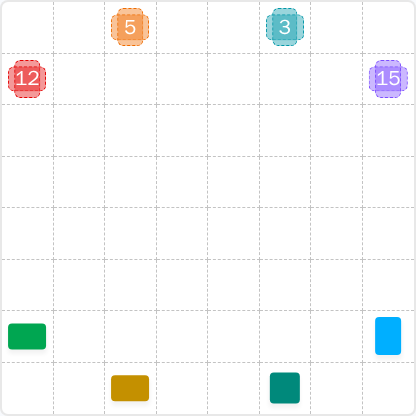
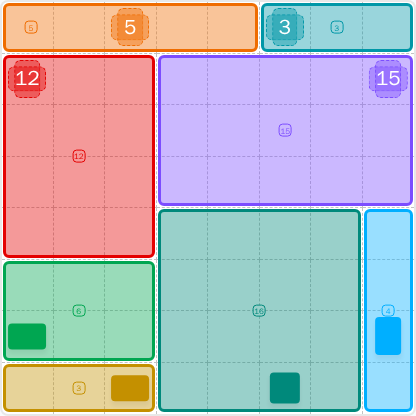
- The Prime Top Row (Starting Point): Look at the Orange 5 and Light Blue 3 in the top row. Both 5 and 3 are prime numbers, meaning they can only form 1x5 and 1x3 rectangles. The grid is exactly 8 squares wide. Since 5 + 3 = 8, these two shapes perfectly lock in the entire top row horizontally.
- The Square Anchor: Shift your attention to the bottom. The blank clues feature specific shapes. The Dark Green clue has a distinct square icon. To fit into the remaining grid without choking off the right side, it must expand into a massive 4x4 square (Area = 16), anchoring the bottom right-center.
- The Squeeze Play: With the top row full and the Dark Green 16 dominating the bottom, the Blue clue (vertical rectangle icon) is forced into the remaining right-hand column to become a 1x4 strip. The Purple 15 is a semiprime (3x5 or 1x15). It perfectly slides into the 3x5 void just beneath the Light Blue 3.
- The Left-Side Cleanup: The right side is now solved, pushing the Red 12 into a 3x4 vertical block on the left. The remaining bottom-left void is neatly split by the Green and Mustard clues. Since both have horizontal rectangle icons, they stack perfectly as a 2x3 (Area = 6) and a 1x3 (Area = 3).
🎓 Lessons Learned From Patches #54
- The Prime Perimeter Strategy: Prime numbers located near edges (like the 5 and 3 here) are massive gifts. Because they can only be 1-cell thick, they almost always run flush against the perimeter to avoid trapping empty cells behind them.
- Iconography is Everything: Many players get stuck on blank clues because they ignore the shape of the icon inside the clue cell. A square icon means a perfect square (2x2, 3x3, 4x4). Consistent practice reading these visual constraints is the secret to increasing your solving speed.
💡 Trivia
- The 25% Anchor: The Dark Green 4x4 square (Area = 16) takes up exactly 25% of the entire 64-square game board. Anchoring the largest square first is a fundamental strategy in spatial packing puzzles!
- The Semiprime Lock: The number 15 is known in mathematics as a "semiprime"—the product of exactly two prime numbers (3 and 5). In grid puzzles, this is highly advantageous because it eliminates guesswork; unlike 12 or 16, a 15-block will always be a 3x5 rectangle unless the board is 15 cells wide.
❓ FAQ
Why couldn't the Light Blue 3 be placed vertically?
A vertical 1x3 in the top right corner would block the Purple 15 from expanding properly. More importantly, it would trap empty cells in the corner, violating the core rule that every cell must belong to a completed shape.
How do you know the Dark Green blank is a 16 and not a 9?
The Dark Green clue’s icon dictates a perfect square. If you made it a 3x3 (Area = 9), you would not leave enough contiguous space for the Blue vertical rectangle to reach the bottom corner while properly accommodating the massive Purple 15 above it.
What happens if I make the Red 12 a 2x6 instead of a 3x4?
A 2x6 vertical layout would intrude too far into the bottom-left region. This would make it mathematically impossible to fit both the Green and Mustard horizontal rectangles into the remaining space without overlapping or leaving orphaned cells.