
LinkedIn Patches #55 Answer
Stuck on today’s grid? Get the LinkedIn Patches #55 solution and expert logic to maintain your streak instantly. Beyond the answer, explore our tactical hints to refine your spatial reasoning and master the game through daily practice.
LinkedIn Patches #55 has ended!
You're viewing an older LinkedIn Patches answer. Click below to see today's latest Patches #78 answer and challenge!
View Today's Patches AnswerPatches #55 Answer
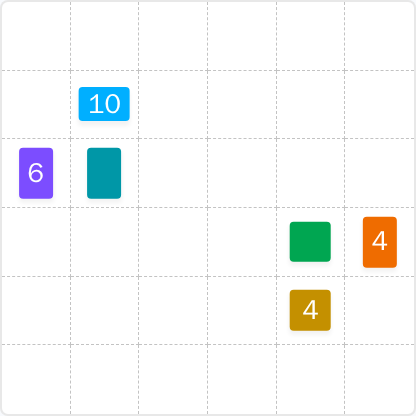
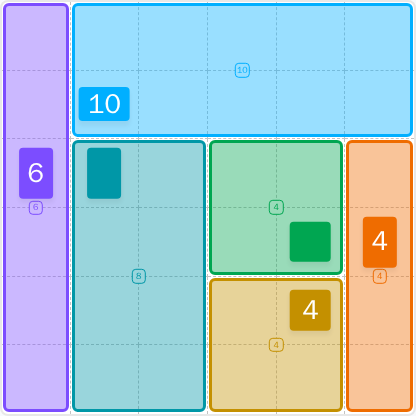
Patches #55 Expert Logic
🧩 Deep Logic Analysis
This puzzle hinged on identifying the single most constrained piece on the board. The key wasn't in the middle, but right on the edge.
-
The Starting Anchor (Purple 6): The most crucial starting point is the Purple 6. Its clue is in the first column. A '6' can be a 1x6, 6x1, 2x3, or 3x2. However, the clue for the Blue 10 is located immediately to its right in column 2. This proximity acts as a wall, preventing the Purple 6 from being 2 or 3 cells wide. It is therefore forced to be contained entirely within column 1, making it a 6x1 vertical rectangle. This single deduction locks down the entire left edge of the grid.
-
The First Chain Reaction (Blue 10): With the left edge defined, the Blue 10 is our next target. On a 6x6 grid, a '10' can only be a 2x5 or a 5x2 rectangle. Since column 1 is now occupied, the 10-patch cannot be 5 cells tall (a 2x5 vertical). Its only remaining possibility is a 5x2 horizontal rectangle, which perfectly fills the top two rows from column 2 to column 6.
-
Dividing the Board: Solving the Purple 6 and Blue 10 effectively splits the grid in two. We've solved the top section, leaving a clean 4x5 rectangular area below it to solve for the remaining pieces. This "divide and conquer" approach is fundamental to good practice.
-
Solving the Right Flank (Orange 4): Now look at the remaining space. The Orange 4 clue sits in the far-right column. To maintain a clean, rectangular tiling, placing it as a 4x1 vertical strip along that right edge is the most logical move. It neatly fills the remaining height of the grid in that column.
-
The Final Fit (Teal, Green, and Gold): With the Orange 4 in place, we are left with a 4x4 space for the Teal, Green, and Gold shapes. The Teal clue is on the left of this space, and its shape resolves into a 4x2 rectangle, taking up two columns. This leaves a final 2x4 vertical space for the Green 4 and Gold 4. The only way to tile a 2x4 area with two 4-patches is with two 2x2 squares. The Green clue is positioned above the Gold clue, so the Green 2x2 square takes the top spot, and the Gold 2x2 takes the bottom.
🎓 Lessons Learned From Patches #55
- The "Edge Constraint" Rule: Always scan the perimeter first. A clue positioned on an edge, especially when blocked by another clue, often has its shape severely restricted. The Purple 6 was forced into a 6x1 configuration, providing the perfect anchor for the entire solve.
- Deduce, Don't Guess: Notice we never had to guess. Each step was a logical consequence of the previous one. The Purple 6's placement forced the Blue 10's shape. That, in turn, created a new, smaller puzzle area. This sequential deduction is the core of the game.
- Recognize Square Potential: The numbers 4 and 9 are your best friends in Patches because they can form squares. When you were left with the final 2x4 area for two 4-patches, the 2x2 square was the immediate and only solution. Developing an eye for this through practice is key.
💡 Trivia
- Perfect Numbers: The Purple 6 is the first "perfect number"—an integer that is the sum of its proper positive divisors (1 + 2 + 3 = 6). The next perfect number is 28.
- Tetrominoes vs. Squares: The Green and Gold 4-patches are 2x2 squares, which is one of the five free "tetrominoes" (shapes made of four connected squares). You might recognize tetrominoes from the classic game Tetris!
❓ FAQ
Why couldn't the Purple 6 be a 2x3 rectangle?
The clue for the Purple 6 is located in the very first column of the grid. For it to be a 2x3 rectangle, it would need to occupy both column 1 and column 2. However, the clue for the Blue 10 is already in column 2, effectively blocking any shape from column 1 from entering that space. This forced the Purple 6 to be contained entirely within its original column, making a 6x1 shape the only possibility.
How was the Blue 10 shape determined to be a 5x2 rectangle?
On a 6x6 grid, a 10-cell shape can only have dimensions of 2x5 or 5x2. After we established that the Purple 6 occupied the entire first column, it became impossible for the Blue 10 to be a 2x5 vertical rectangle (2 cells wide and 5 cells tall), as it couldn't cross into the occupied space. Therefore, the only remaining configuration was a 5x2 horizontal rectangle, which fit perfectly across the top of the grid.
Couldn't the three shapes on the right have been arranged differently?
This is a common point of confusion. Once the Teal 8-patch was placed as a 4x2, it left a 2x4 vertical space for the Green 4 and Gold 4. While you could theoretically place two 1x4 strips in that space, the clues themselves are in different columns (column 4 and 5). A 1x4 strip can't contain clues that are horizontally separated. The only shape that could contain clues in adjacent columns and fit perfectly was the 2x2 square, making it the only logical solution for both the Green and Gold patches.