
LinkedIn Patches #57 Answer
Stuck on today’s grid? Get the LinkedIn Patches #57 solution and expert logic to maintain your streak instantly. Beyond the answer, explore our tactical hints to refine your spatial reasoning and master the game through daily practice.
LinkedIn Patches #57 has ended!
You're viewing an older LinkedIn Patches answer. Click below to see today's latest Patches #78 answer and challenge!
View Today's Patches AnswerPatches #57 Answer
Patches #57 Expert Logic
🧩 Deep Logic Analysis
Today's 6x6 grid was a masterclass in using constraints to create a cascade of solutions. The key was to identify the most restricted pieces first, which then forced the others into place.
Here’s the step-by-step breakdown:
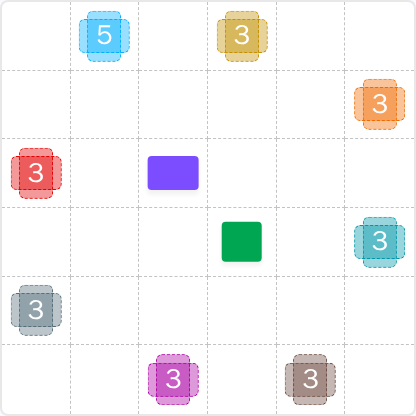
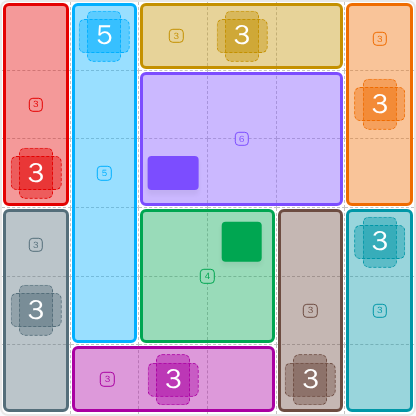
- The Prime Suspect: The most powerful starting clue was the Blue 5. Prime numbers are a gift in Patches because their shapes are limited to 1xN strips. Since the Blue 5 is in the second column, a 5x1 horizontal strip is impossible—it would run off the grid. Therefore, it must be a 1x5 vertical strip. This one move immediately defines a massive portion of the board.
- The Left-Side Domino Effect: Placing the 1x5 Blue strip creates a wall. The Red 3 on the far-left edge cannot expand to the right. This forces it into a 1x3 vertical shape. Following that, the Gray 3 in the bottom-left corner is also boxed in by the Red shape above it and the left edge. It has no choice but to become a 1x3 vertical strip, perfectly filling the first column.
- The Central Mystery: The two un-numbered clues (the Purple and Green squares) were the next logical step. By summing the areas of all the numbered clues (5+3+3+3+3+3+3+3 = 26) and subtracting from the total grid area (36), we know the Green and Purple shapes must have a combined area of 10. The most common combinations are (4, 6) or (2, 8).
- The Square Peg in a Square Hole: Given the remaining space in the center, a 2x2 square (area 4) and a 3x2 rectangle (area 6) fit perfectly. An 8-area shape would be too large for the constrained space. We can deduce the Green shape is a 2x2 square (Area 4) and the Purple shape is a 3x2 rectangle (Area 6). With enough practice, you learn to spot these geometric fits instinctively.
- Finishing the Puzzle: With the center locked in, the rest is a chain reaction. The Pink 3 at the bottom is squeezed between the Gray strip and the Green square, forcing it into a 3x1 horizontal shape. This, in turn, confines the Brown 3, Teal 3, and Orange 3 into their respective 1-cell-wide columns, forcing them all to be 1x3 vertical strips. Finally, the Gold 3 fills the remaining 3x2 space at the top, completing its 6-area shape.
🎓 Lessons Learned From Today's Puzzle
- The Prime Pillar Strategy: Always start by identifying prime-numbered clues (like 5, 7, 11). Their 1xN shape restriction, combined with their position near an edge, often provides the most decisive first move you can make.
- Solve by Subtraction: When faced with un-numbered clues, use the "Area Summation" technique. Calculate the total grid area, subtract the sum of the known clues, and use the remainder to deduce the areas of the unknown shapes. This turns a guess into a calculated deduction.
- Let the Walls Close In: Don't be afraid to place a large, definitive piece like the Blue 1x5 strip early on. These large shapes act as internal walls, drastically reducing the possibilities for all adjacent clues and creating a domino effect of forced placements.
💡 Trivia
- Perfectly Logical: The Purple and Gold shapes both have an area of 6. The number 6 is the smallest "perfect number"—an integer that is the sum of its own proper divisors (1 + 2 + 3 = 6). The next one is 28.
- The Power of Four: The Green shape is a 2x2 square with an area of 4. Four is the smallest composite number (a non-prime number) and the only square that is one more than a prime number (3+1).
❓ FAQ
Why did the Green and Purple shapes have to be areas 4 and 6? Couldn't they have been 2 and 8?
While their areas do sum to 10, the geometry doesn't work. After placing the mandatory 1x5 Blue strip and its neighbors, the remaining central space isn't large enough to accommodate an 8-area rectangle (like a 2x4 or 1x8). The combination of a 2x2 square (area 4) and a 3x2 rectangle (area 6) was the only one that could physically fit into the constrained space. Consistent practice is key to quickly visualizing these spatial impossibilities.
Why couldn't the Blue 5 be a 5x1 horizontal strip?
The Blue 5 clue is positioned in the second column from the left edge of the 6x6 grid. A horizontal strip needs five adjacent cells. From that starting point, a 5x1 strip would extend past the grid's boundary, which isn't allowed. This is a fundamental rule of the game, forcing its orientation to be a 1x5 vertical strip.
I got stuck on the right side. How were the Orange, Teal, and Brown shapes determined?
They were solved through a process of elimination dictated by the central shapes. Once the 3x2 Purple rectangle and the 2x2 Green square were placed, the available space on the right side of the grid became a set of narrow, 1-cell-wide columns. This structural constraint left only one possible orientation for the 3-area shapes: they all had to be 1x3 vertical strips to fit.